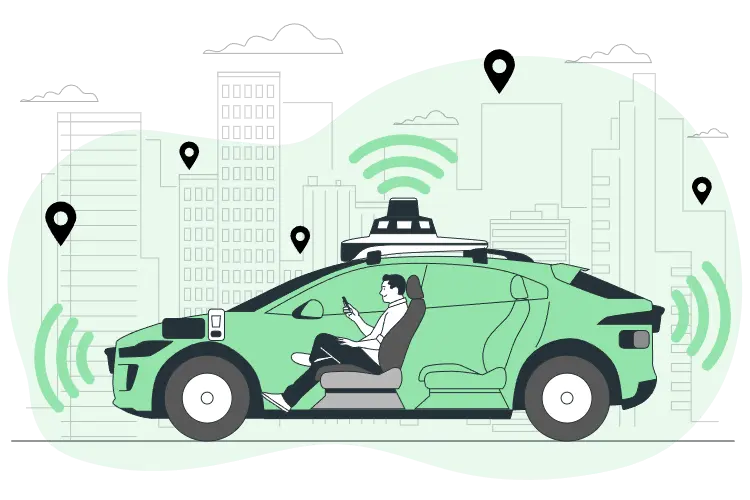
Artificial intelligence has become the fundamental technology reshaping ride-hailing and delivery platforms. Rather than a supplementary enhancement, AI now powers core operational systems—from dispatch algorithms to demand forecasting to fraud detection. The platforms implementing sophisticated AI systems are capturing disproportionate market share while delivering measurably superior user experiences.
Dynamic Demand Prediction and Preemptive Driver Positioning
Machine learning algorithms now predict ride demand with remarkable accuracy, enabling platforms to position drivers before surges materialize. Uber’s predictive models analyze historical data, weather conditions, local events, time of day, traffic patterns, and dozens of other variables to forecast demand spikes 15-30 minutes in advance. Rather than reacting to demand after it appears, these systems proactively position drivers in anticipated high-demand zones.
This predictive capability reduces average wait times substantially. Research demonstrates that integrating demand forecasting with vehicle relocation optimization decreases average waiting times by approximately 30% across all test cases and up to 55% in high-demand zones. For riders, this means consistently shorter wait times and higher ride availability during peak periods.
The same predictive capabilities apply to food delivery. DoorDash’s demand forecasting system analyzes historical order patterns, seasonal trends, time of day, and local events to predict what restaurants will be overwhelmed and which will have capacity. This enables the platform to intelligently distribute orders across restaurants, preventing bottlenecks while ensuring consistent delivery performance. For restaurants, this intelligence enables better inventory management—kitchen staff know exactly what to prepare and when.
Intelligent Real-Time Dispatch and Matching
Modern dispatch systems employ optimization algorithms paired with machine learning to solve what researchers call “the dispatch problem”—assigning hundreds of thousands of orders to appropriate drivers simultaneously while minimizing total delivery time. DoorDash’s dispatch system combines machine learning predictions with advanced optimization to consider multiple factors: driver location and vehicle type, restaurant location and current preparation status, traffic conditions, customer location, and historical performance data.
The system operates on a timeline of seconds—evaluating millions of potential assignments and selecting optimal matches continuously. Critically, these systems learn from outcomes: when actual delivery times differ from predictions, the system captures this variance and incorporates it into future predictions. This continuous learning loop means dispatch efficiency improves over time as the system accumulates more data.
For ride-hailing, intelligent matching considers more than just proximity. Uber’s matching algorithm evaluates driver-rider compatibility based on historical patterns, user preferences, ratings, and trip routes. A driver with consistently high ratings for long trips might be preferentially matched with longer-distance riders, while drivers excellent at quick airport runs receive airport requests. This nuanced matching reduces cancellations and improves satisfaction for both parties.
Precise Estimated Time of Arrival (ETA) Prediction
ETA accuracy represents a critical competitive differentiator. Early ETA systems employed simple mathematical models: calculate distance, divide by average speed. Modern systems employ deep learning models processing continuous data streams—real-time traffic data, weather conditions, historical performance patterns for specific routes, driver behavior patterns, and current network congestion.
Uber Eats developed a sophisticated “Trip State Model” using smartphone motion sensors and GPS data to understand precisely what drivers are doing at each moment: traveling to restaurant, searching for parking, walking to pickup point, waiting for order, en route to customer. By identifying these micro-states accurately, the system predicts preparation time and delivery completion with exceptional accuracy.
This precision enables optimization at multiple levels. The system can dispatch drivers to arrive at restaurants precisely when food preparation completes, eliminating driver wait time. For customers, accurate ETAs reduce anxiety and enable better planning of their evening. The cumulative impact of improved ETAs across millions of daily orders significantly improves user satisfaction and repeat usage.
Route Optimization and Real-Time Traffic Integration
AI-powered route optimization analyzes continuously updated traffic conditions, weather disruptions, road closures, and delivery volume to determine optimal routes dynamically. Unlike traditional GPS navigation optimizing for shortest distance, delivery platform routing optimizes for fastest delivery while accounting for traffic patterns, driver fuel efficiency, and package consolidation. Uber Eats’ route optimization reduces delivery times by up to 25%, ensuring fresher food arrives faster.
The system updates routes in real-time as conditions change. If an accident blocks the primary route, the system automatically redirects drivers through optimal alternative paths without requiring driver input. Weather-aware routing accounts for how conditions affect actual driving speed—rain significantly reduces optimal speeds and increases realistic delivery windows. These micro-optimizations compound across millions of daily deliveries to generate substantial efficiency gains.
Dynamic Pricing and Surge Management
AI algorithms manage dynamic pricing by continuously analyzing supply-demand balances, competitive pricing, and market conditions. Rather than simple multiplier-based surge pricing, modern systems employ sophisticated pricing models that optimize for multiple objectives: incentivizing driver participation during peak times, managing customer demand elasticity, and maximizing platform revenue. Machine learning systems learn which price points optimize for desired outcomes—often balancing driver incentives with customer acquisition rather than purely maximizing per-ride revenue.
Personalized pricing extends further: some platforms employ AI systems that estimate individual customer price sensitivity based on past behavior, account history, and even real-time behavioral signals. A customer with low battery (potentially desperate) might see higher surge prices than a customer actively browsing ride options. While ethically controversial, these systems arguably optimize allocation toward users with genuine need.
For food delivery, AI-driven pricing analyzes demand forecasts, restaurant availability, competitor pricing, and delivery difficulty to adjust fees dynamically. DoorDash’s system incorporates real-time demand signals to implement surge pricing during peak hours while using AI to predict off-peak discounts that drive incremental demand.
Personalized Recommendations and User Experience
AI recommendation engines analyzing user behavior generate highly personalized meal suggestions. Swiggy’s recommendation system identifies food preferences based on order history, location, time of day, and behavioral signals to surface dishes users are most likely to order. Uber Eats and DoorDash employ similar systems that analyze browsing patterns, item views without purchases, and implicit preferences derived from search behavior.
These recommendation systems generate measurable impact: users encountering personalized recommendations place larger orders, increased order frequency, and spend more per order compared to users browsing generic “popular” sections. The system benefits both users—who discover items matching their preferences—and platforms—which increase transaction value.
Beyond food recommendations, AI personalizes entire user experiences. Pricing, promotions, and discounts are customized per-user based on price sensitivity, purchasing patterns, and engagement history. Users likely to order without discounts see full-price offers while price-sensitive users receive targeted promotions. This personalization increases conversion and order volume.
Fraud Detection and Security
AI systems detect fraudulent activities across multiple dimensions: payment fraud, identity theft, fake accounts, and restaurant-side violations. Fraud detection algorithms analyze transaction patterns identifying anomalies: unusual payment methods, geographic inconsistencies, rapid successive transactions, and other suspicious signals. By embedding generative AI into fraud detection systems, some platforms have improved fraud detection rates by as much as 300%.
For delivery platforms, image recognition AI examines delivery photos to detect package tampering, damage, and delivery errors, preventing false claims and ensuring delivery integrity. Driver behavior monitoring tracks driving patterns identifying dangerous behaviors—hard braking, excessive speeding, aggressive maneuvers—enabling intervention to improve safety.
Inventory Management and Kitchen Optimization
Food delivery platforms employ AI to optimize restaurant inventory and kitchen operations. DoorDash’s system analyzes demand forecasts and historical patterns to predict which menu items will be popular, enabling restaurants to prepare optimal inventory levels. This reduces food waste from overstocking while preventing shortage-related delays from understocking.
AI also optimizes kitchen staffing and equipment utilization by predicting order volumes and meal preparation times, enabling restaurants to schedule labor and manage capacity more efficiently. Zomato uses AI to identify trending food items and create personalized menus, increasing engagement and driving repeat orders.
Autonomous Vehicle Integration and Robotaxis
The most transformative AI development is autonomous vehicle integration. Robotaxis powered by advanced AI systems are transitioning from experimental pilot programs to commercial operation across major U.S. cities. Waymo operates fully driverless robotaxi services across multiple markets, with Amazon’s Zoox, Tesla, and Uber pursuing aggressive robotaxi deployment timelines. Nvidia’s DRIVE platform and Mercedes-Benz integration indicate that robotaxi technology is approaching mainstream commercialization.
Remote monitoring represents a critical safety innovation—rather than removing human oversight entirely, companies are implementing remote human operators who can monitor and intervene in robotaxi operations when needed. This hybrid approach maintains safety while improving scalability.
For autonomous delivery, robots are navigating sidewalks at scale in pilot programs, addressing last-mile delivery challenges for package delivery and meal delivery. These systems employ computer vision, LIDAR sensors, and path-planning algorithms to navigate complex urban environments safely.
Boston Consulting Group projects that by 2035, robotaxis could comprise 700,000 to 3 million vehicles globally, potentially replacing 55-85% of ride-hailing and taxi trips in major developed cities. Operational break-even is estimated within seven years as technology matures and manufacturing scales.
Real-Time Analytics and Decision Optimization
Modern platforms process billions of data points daily through ML pipelines that continuously optimize performance. Lyft’s real-time monitoring tracks model performance metrics like latency and accuracy, enabling rapid identification and correction of degrading models. When DoorDash detected unexpected changes in customer ordering patterns and external factors affecting model performance, real-time monitoring enabled rapid retraining, preventing operational disruptions.
This continuous optimization extends to A/B testing at massive scale—platforms test thousands of variations simultaneously (UI changes, pricing models, recommendation algorithms, matching strategies) to identify improvements generating measurable impact. The rapid iteration enabled by these systems compounds to substantial cumulative improvements.
Chatbots and Conversational AI for Customer Support
Natural language processing and generative AI power customer service chatbots handling 80% of routine inquiries (tracking orders, reporting issues, processing refunds) instantly while escalating complex problems to human agents. These systems understand conversational context and provide helpful information without frustrating users with rigid menu-based support.
Voice ordering represents an emerging frontier—AI systems understand natural language voice commands enabling hands-free ordering for accessibility and convenience. Users can simply state “I’d like a large pepperoni pizza with extra cheese and light sauce” and the system processes the entire order without requiring manual selection.
Traffic Management and Urban Optimization
City-level AI systems coordinate ride-hailing and delivery vehicles with broader transportation infrastructure. AI manages traffic signals, adjusts timing based on real-time flow data, and coordinates vehicle routing across entire metropolitan areas. This systemic optimization reduces congestion that would otherwise result from increased ride-hailing and delivery vehicle volumes.
Implementation Challenges and Future Evolution
Despite remarkable achievements, AI systems in ride-hailing and delivery face ongoing challenges: model degradation as user behavior shifts, edge cases and safety scenarios not adequately represented in training data, and the computational overhead of real-time optimization at global scale. Robustness and interpretability remain areas requiring continued development.
Future evolution will likely involve “agentic AI”—systems operating more autonomously and making independent decisions within defined parameters. These systems could dynamically adjust pricing, modify dispatch strategies, and coordinate vehicle fleets without continuous human oversight. The emergence of multimodal AI combining vision, language, and reasoning capabilities will enable more sophisticated understanding of complex scenarios.
Competitive Implications
The platforms implementing the most sophisticated AI systems are capturing disproportionate market share. Uber’s superior ETA predictions, route optimization, and demand forecasting create compound advantages in user experience and operational efficiency. DoorDash’s dispatch optimization and restaurant partnership analytics enable delivery times competitors struggle to match. These technical advantages translate directly to competitive moats that smaller competitors find difficult to overcome.
Summary: AI as Foundational Infrastructure
AI has evolved from an optional optimization layer to the foundational infrastructure enabling modern ride-hailing and delivery. Platforms without sophisticated AI systems for demand prediction, dispatch optimization, and personalization will increasingly struggle against competitors leveraging these technologies systematically. The convergence of autonomous vehicles, real-time optimization, and personalization represents the next evolution—creating fully autonomous, AI-orchestrated transportation and delivery ecosystems that would have seemed impossible a decade ago. For riders and customers, this evolution promises faster service, lower costs, better user experiences, and ultimately, fully autonomous fleets that eliminate human limitations in safety, efficiency, and responsiveness.